Showing posts with label Evolution. Show all posts

NIH sets aside more than $40 million for study of human placenta


The Human Placenta Project, launched last year by the National Institutes of Health (NIH) despite uncertainty over how much money would back in the effort, has just received a whopping $41.5 million in 2015 to study the vital mass of tissue that sustains a developing fetus.

The placenta carries nutrients and oxygen to a fetus from its mother’s bloodstream and removes waste; problems with its performance may contribute to health concerns ranging from preterm birth to adult diabetes. Yet it is the least understood human organ, according to Alan Guttmacher, director of NIH’s National Institute of Child Health and Human Development (NICHD). 

Last year, Science reported on a NICHD workshop where planning began for a Human Placenta Project that would aim to monitor the placenta during a woman’s pregnancy, using new imaging approaches, tests for fetal molecules shed into a mother’s blood, and other tools.

That plan is reflected in the title of a 26 February request for grant applications, from NICHD and the National Institute of Biomedical Imaging and Bioengineering (NIBIB), that calls for “Paradigm-Shifting Innovations” in how to assess the human placenta. One objective is to learn how environmental factors such as a mother’s diet and exposure to pollutants affect the placenta. The $41.5 million will support eight to nine awards lasting up to 4 years.

The new funding commitment for the project comes on top of about $4.5 million in 2015 that NICHD and NIBIB have already set aside for research on tools to study the placenta. An NIH representative says that some of the additional $41.5 million could come from leftover funding from the National Children’s Study (NCS), a controversial plan to follow the health of 100,000 children for 21 years that NIH canceled in December. NIH is now looking for ways to spend $140 million that Congress appropriated for the NCS in 2015 on related studies.

Article: ScienceMag

Let’s call it: 30 years of above average temperatures means the climate has changed


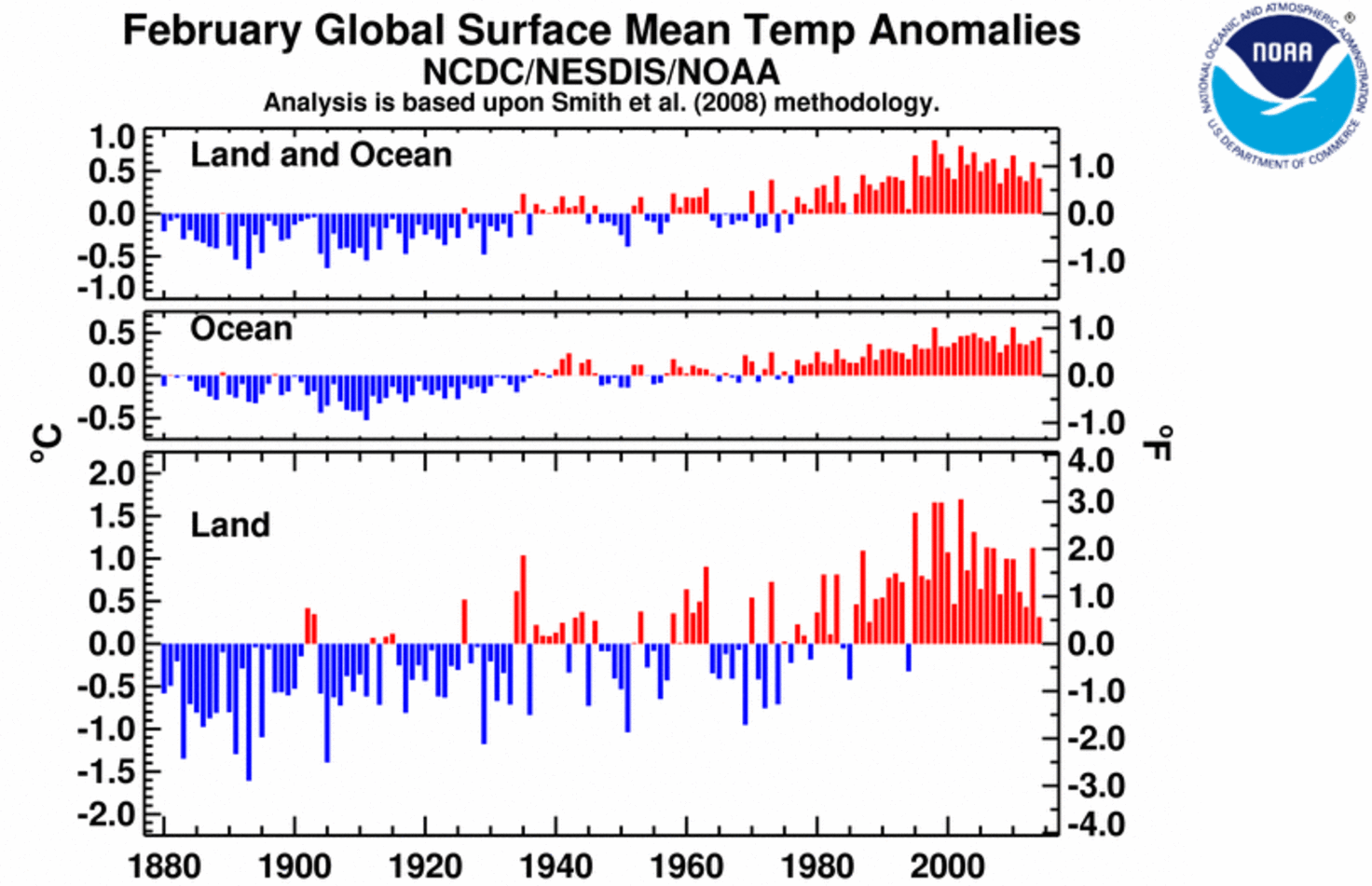
If you’re younger than 30, you’ve never experienced a month in which the average surface temperature of the Earth was below average.

Each month, the US National Climatic Data Center calculates Earth’s average surface temperature using temperature measurements that cover the Earth’s surface. Then, another average is calculated for each month of the year for the twentieth century, 1901-2000. For each month, this gives one number representative of the entire century. Subtract this overall 1900s monthly average – which for February is 53.9F (12.1C) – from each individual month’s temperature and you’ve got the anomaly: that is, the difference from the average.

The last month that was at or below that 1900s average was February 1985. Ronald Reagan had just started his second presidential term and Foreigner had the number one single with “I want to know what love is.”

These temperature observations make it clear the new normal will be systematically rising temperatures, not the stability of the last 100 years. The traditional definition of climate is the 30-year average of weather. The fact that – once the official records are in for February 2015 – it will have been 30 years since a month was below average is an important measure that the climate has changed.

Temperature history for all Februaries from 1880-2014  NCDC


How the Earth warms

As you can see in the graphic above, ocean temperature doesn’t vary as much as land temperature. This fact is intuitive to many people because they understand that coastal regions don’t experience as extreme highs and lows as the interiors of continents. Since oceans cover the majority of the Earth’s surface, the combined land and ocean graph strongly resembles the graph just for the ocean. Looking at only the ocean plots, you have to go all the way back to February 1976 to find a month below average. (That would be under President Gerald Ford’s watch.)

You can interpret variability over land as the driver of the ups and downs seen in the global graph. There are four years from 1976 onwards when the land was below average; the last time the land temperature was cool enough for the globe to be at or below average was February 1985. The flirtation with below-average temps was tiny – primarily worth noting in the spirit of accurate record keeping. Looking at any of these graphs, it’s obvious that earlier times were cooler and more recent times are warmer. None of the fluctuations over land since 1976 provide evidence contrary to the observation that the Earth is warming.

Some of the most convincing evidence that the Earth is warming is actually found in measures of the heat stored in the oceans and the melting of ice. However, we often focus on the surface air temperature. One reason for that is that we feel the surface air temperature; therefore, we have intuition about the importance of hot and cold surface temperatures. Another reason is historical; we have often thought of climate as the average of weather. We’ve been taking temperature observations for weather for a long time; it is a robust and essential observation.

Temperature history for every year from 1880-2014.  NOAA National Climatic Data Center


Despite variability, a stable signal

Choosing one month, February in this instance, perhaps overemphasizes that time in 1985 when we had a below average month. We can get a single yearly average for all the months in an entire year, January-December. If we look at these annual averages, then the ups and downs are reduced. In this case, 1976 emerges as the last year in which the global-average temperature was below the 20th century average of 57.0F (13.9C) – that’s 38 years ago, the year that Nadia Comaneci scored her seven perfect 10s at the Montreal Olympics.

I am not a fan of tracking month-by-month or even year-by-year averages and arguing over the statistical minutia of possible records. We live at a time when the Earth is definitively warming. And we know why: predominately, the increase of greenhouse gas warming due to increasing carbon dioxide in the atmosphere. Under current conditions, we should expect the planet to be warming. What would be more important news would be if we had a year, even a month, that was below average.

The variability we observe in surface temperature comes primarily from understood patterns of weather. Many have heard of El Niño, when the eastern Pacific Ocean is warmer than average. The eastern Pacific is so large that when it is warmer than average, the entire planet is likely to be warmer than average. As we look at averages, 30 years, 10 years, or even one year, these patterns, some years warmer, some cooler, become less prominent. The trend of warming is large enough to mask the variability. The fact that there have been 30 years with no month below the 20th century average is a definitive statement that climate has changed.

To see a cooler Earth any time soon, you’ll need to carve one out of ice.  Kirsten Spry, CC BY-NC-SA


The 30-year horizon

There are other reasons that this 30-year span of time is important. Thirty years is a length of time in which people plan. This includes personal choices – where to live, what job to take, how to plan for retirement. There are institutional choices – building bridges, building factories and power plants, urban flood management. There are resource management questions – assuring water supply for people, ecosystems, energy production and agriculture. There are many questions concerning how to build the fortifications and plan the migrations that sea-level rise will demand. Thirty years is long enough to be convincing that the climate is changing, and short enough that we can conceive, both individually and collectively, what the future might hold.

Finally, 30 years is long enough to educate us. We have 30 years during which we can see what challenges a changing climate brings us. Thirty years that are informing us about the next 30 years, which will be warmer still. This is a temperature record that makes it clear that the new normal will be systematically rising temperatures, not the ups and downs of the last 100 years.

Those who are under 30 years old have not experienced the climate I grew up with. In thirty more years, those born today will also be living in a climate that, by fundamental measures, will be different than the climate of their birth. Future success will rely on understanding that the climate in which we are all now living is changing and will continue to change with accumulating consequences.

Story: TheConversation

Scientists discover black hole so big it contradicts growth theory


Scientists say they have discovered a black hole so big that it challenges the theory about how they grow.

Scientists said this black hole was formed about 900 million years after the Big Bang.

But with measurements indicating it is 12 billion times the size of the Sun, the black hole challenges a widely accepted hypothesis of growth rates.

"Based on previous research, this is the largest black hole found for that period of time," Dr Fuyan Bian, Research School of Astronomy and Astrophysics, Australian National University (ANU), told Reuters on Wednesday.

"Current theory is for a limit to how fast a black hole can grow, but this black hole is too large for that theory."

The creation of supermassive black holes remains an open topic of research. However, many scientists have long believed the growth rate of black holes was limited.

Black holes grow, scientific theory suggests, as they absorb mass. However, as mass is absorbed, it will be heated creating radiation pressure, which pushes the mass away from the black hole.

"Basically, you have two forces balanced together which sets up a limit for growth, which is much smaller than what we found," said Bian.

The black hole was discovered a team of global scientists led by Xue-Bing Wu at Peking University, China, as part of the Sloan Digital Sky Survey, which provided imagery data of 35 percent of the northern hemisphere sky.

The ANU is leading a comparable project, known as SkyMapper, to carry out observations of the Southern Hemisphere sky.

Bian expects more black holes to be observed as the project advances.

(Editing by Robert Birsel)

Pink cloud from NASA rocket lights up sky over U.S. Southwest


An unusual pink cloud that lit up the sky over New Mexico and Arizona early on Wednesday was caused by a NASA research rocket launched to study the outer reaches of Earth's atmosphere, scientists said.

The cloud stunned many residents who posted photographs online and speculated on social media about its cause, with theories ranging from shootings stars to the sprightly fictional character Peter Pan.

But researchers at the White Sands Missile Range in southern New Mexico said the fluffy phenomenon had a much more Earth-bound explanation.

They said it was caused by a Terrier-Black Brant rocket designed to reach an altitude of more than 100 miles (160 km) that released a small quantity of vapor - "about as much as is contained in a BBQ grill propane tank" - into the near-vacuum of space to study the formation of the ionosphere.

The ionosphere is the outer layer of the atmosphere that extends to about 370 miles (600 km) into space.

The White Sands scientists said in a statement the colorful cloud was formed "as the sun illuminates the vapor before it diffuses harmlessly away into space."

Ground stations across the U.S. Southwest took a variety of measurements during the experiment, the researchers said. The data will be used to develop enhanced models of ionospheric disturbances in near-Earth space and their effects on modern technologies.

(Reporting by Daniel Wallis in Denver; Editing by Bill Trott)

Brain activity shows infants are hardwired to link images, sounds as they learn to speak

Child learning (stock image). An international team of researchers in the UK and in Japan examined the electrical activities of the brain in 11 month-olds at the initial stages of word learning.
Credit: © mitgirl / Fotolia

New research examining electrical brain activity in infants suggests that we are biologically predisposed to link images and sounds to create language.

In a paper published in the journal Cortex, an international team of researchers in the UK and in Japan, including those at the University of Warwick, examined the electrical activities of the brain in 11 month-olds at the initial stages of word learning.

They used novel words ('kipi' or 'moma') to refer to pictures of a spiky or a rounded shape. They found the infants very quickly began to match the word to the image.

One of the authors, Dr Sotaro Kita from the University of Warwick said: 

"The oscillatory activity of the infant brainincreased when the word they heard matched the shape they were shown, compared to when it did not. This suggests that the infant brain spontaneously engages in matching visual and auditory input."

An analysis of how different areas of the brain are communicating with each other also showed surprising results.

Dr Kita said: "Communication traffic between regions of the brain was light when the word matched the shape, but the traffic became heavy especially in the left hemisphere, where language is typically processed, when the word did not match the shape. The left-hemisphere had to work harder to associate visual and auditory input when they are not a natural match."


"The N400 response was higher for mismatching word-image pairs, which is a classic index of word meaning processing in the brain. This indicates that the infants were trying to work out the meaning of the novel words."

Dr Kita added that these findings reveal that sound symbolism allows 11-month-old infants to spontaneously bind the speech sound and the visual referent, and this spontaneous binding may provide infants an insight that spoken words refers to objects you can see in the world.


He said: "It is this cross-modal mapping between sound and image that plays a key role in the origin and development of language-learning."


Story Source: The above story is based on materials provided by University of Warwick
Note: Materials may be edited for content and length.

Did dark matter kill the dinosaurs?


Every so often, the fossil record shows, ecological disasters wipe large numbers of species off the face of Earth. These mass extinctions occur roughly every 26 million to 30 million years—about the same interval at which our solar system passes through the plane of the Milky Way. Putting two and two together, some researchers have proposed that clouds of dust and gas in the galactic plane might disrupt the orbits of far-flung comets and trigger planet-smacking collisions. A new study suggests an additional culprit may lie behind those times of woe: dark matter.

Some of Earth’s past mass extinctions have been caused by the impacts of extraterrestrial objects, such as the asteroid that struck near Mexico’s Yucatán Peninsula and wiped out the dinosaurs about 66 million years ago. Others have occurred during extended periods of geological disruption that include region-smothering volcanic eruptions. Both kinds of catastrophes seem to occur on a cycle of about 30 million years, notes Michael Rampino, a geoscientist at New York University in New York City. 

“It’s always been a mystery as to how extraterrestrial impacts could cause these long-lived geological effects,” he says. But invisible dark matter, he proposes, could trigger both extraterrestrial impacts and geological upheavals in one fell swoop.

Scientists still don’t know what dark matter is, but its gravitational pull on other objects in space shows that there’s a lot of it out there. Researchers estimate that in the plane of the galaxy, each square light-year contains about one solar mass of dark matter. Like the clouds of dust and gas that astronomers can see, clouds of dark matter may be perturbing the orbits of distant comets, causing them to fall into the inner solar system where they can strike Earth.

But those clouds could directly affect Earth as well, Rampino says. As the solar system passes through this purported haze of particles clogging the galactic plane, some get trapped by Earth’s gravity, Rampino suggests. These particles orbit Earth’s core and eventually fall to the center of the planet, where they interact with normal matter or one another, releasing energy that gets transformed into heat.

In the time it takes for the solar system to cross the galactic plane, interactions with dark matter could raise the temperature of Earth’s core by hundreds of degrees Celsius, Rampino reported online this week in the Monthly Notices of the Royal Astronomical Society. Then, over millions of years, that heat could be carried to Earth’s surface via massive plumes of hot buoyant rock that, in turn, create volcanic hot spots or slowly rip apart continents—possibly altering global climate or making huge swaths of the planet so inhospitable that millions of species perish.

The idea that dark matter might cause both extraterrestrial impacts and geological upheavals “is intriguing,” says Dennis Kent, a geophysicist at the Lamont-Doherty Earth Observatory in Palisades, New York. “One of those sources of environmental disruption might be tolerable,” he notes, but together they might pack a one-two punch that is too much for many ecosystems to bear. Indeed, he adds, some rather large impacts that weren’t accompanied by widespread geological devastation—such as an object that slammed into what is now the Chesapeake Bay nearly 35 million years ago, leaving a now-buried crater—don’t seem to have caused significant ecological damage.

Credits: Sciencemag

Newborn neurons in adult brain may help us adapt to environment


The discovery that the human brain continues to produce new neurons in adulthood challenged a major dogma in the field of neuroscience, but the role of these neurons in behavior and cognition is still not clear. In a review article published by Cell Press February 21st in Trends in Cognitive Sciences, Maya Opendak and Elizabeth Gould of Princeton University synthesize the vast literature on this topic, reviewing environmental factors that influence the birth of new neurons in the adult hippocampus, a region of the brain that plays an important role in memory and learning.

The authors discuss how the birth of such neurons may help animals and humans adapt to their current environment and circumstances in a complex and changing world. They advocate for testing these ideas using naturalistic designs, such as allowing laboratory rodents to live in more natural social burrow settings and observing how circumstances such as social status influence the rate at which new neurons are born.

"New neurons may serve as a means to fine-tune the hippocampus to the predicted environment," Opendak says. "In particular, seeking out rewarding experiences or avoiding stressful experiences may help each individual optimize his or her own brain. However, more naturalistic experimental conditions may be a necessary step toward understanding the adaptive significance of neurons born in the adult brain."

In recent years, it has become increasingly clear that environmental influences have a profound effect on the adult brain in a wide range of mammalian species. Stressful experiences, such as restraint, social defeat, exposure to predator odors, inescapable foot shock, and sleep deprivation, have been shown to decrease the number of new neurons in the hippocampus. By contrast, more rewarding experiences, such as physical exercise and mating, tend to increase the production of new neurons in the hippocampus.

The birth of new neurons in adulthood may have important behavioral and cognitive consequences. Stress-induced suppression of adult neurogenesis has been associated with impaired performance on hippocampus-dependent cognitive tasks, such as spatial navigation learning and object memory. Stressful experiences have also been shown to increase anxiety-like behaviors that are associated with the hippocampus. In contrast, rewarding experiences are associated with reduced anxiety-like behavior and improved performance on cognitive tasks involving the hippocampus.

Although scientists generally agree that our day-to-day actions change our brains even in adulthood, there is some disagreement on the adaptive significance of new neurons. For instance, the literature presents mixed findings on whether new neurons generated under a specific experimental condition are geared toward the recognition of that particular experience or if they provide a more naive pool of new neurons that enable environmental adaptation in the future.

Gould and her collaborators recently proposed that stress-induced decreases in new neuron formation might improve the chances of survival by increasing anxiety and inhibiting exploration, thereby prioritizing safety and avoidant behavior at the expense of performing optimally on cognitive tasks. On the other hand, reward-induced increases in new neuron number may reduce anxiety and facilitate exploration and learning, leading to greater reproductive success.

"Because the past is often the best predictor of the future, a stress-modeled brain may facilitate adaptive responses to life in a stressful environment, whereas a reward-modeled brain may do the same but for life in a low-stress, high-reward environment," says Gould, a professor of psychology and neuroscience at Princeton University.
However, when aversive experiences far outnumber rewarding ones in both quantity and intensity, the system may reach a breaking point and produce a maladaptive outcome. For example, repeated stress produces continued reduction in the birth of new neurons, and ultimately the emergence of heightened anxiety and depressive-like symptoms.

"Such a scenario could represent processes that are engaged under pathological conditions and may be somewhat akin to what humans experience when exposed to repeated traumatic stress," Opendak says.

Because many studies that investigate adult neurogenesis use controlled laboratory conditions, the relevance of the findings to real-world circumstances remains unclear. The use of a visible burrow system--a structure consisting of tubes, chambers, and an open field--has allowed researchers to recreate the conditions that allow for the production of dominance hierarchies that rats naturally form in the wild, replicating the stressors, rewards, and cognitive processes that accompany this social lifestyle.

"This more realistic setting has revealed individual differences in adult neurogenesis, with more new neurons produced in dominant versus subordinate male rats," Gould says. "Taking findings from laboratory animals to the next level by exploring complex social interactions in settings that maximize individual variability, a hallmark of the human experience, is likely to be especially illuminating."

The above story is based on materials provided by Cell Press. Note: Materials may be edited for content and length.


Mars One mission: Watch the trailer for £4bn colonisation programme


Five Britons have been shortlisted for a one-way trip to Mars as they hope to become the first humans to step foot on the Red Planet.

Four women and a man from the UK are among the final 100 candidates for the Mars One Project which plans to set up a permanent human settlement on the planet by 2024.
More than 200,000 people applied for the controversial privately-funded mission that organisers have estimated will cost £3.9 billion and is set to be filmed for a reality television series.

Hannah Earnshaw, 23, a PhD student in astronomy at Durham University, is among the British hopefuls, who include students and researchers in physics and astrophysics, a science lab technician and a manager for Virgin Media.

She said: "Human space exploration has always interested me so the opportunity to be one of the people involved was really appealing. The future of humanity is in space.
"My family is pretty thrilled. They're really happy for me. Obviously it's going to be challenging, leaving Earth and not coming back. I've had support from my friends and family and we can still communicate via the internet."


Ms Earnshaw said she will now be tested in groups on her response to stressful situations before finding out at the end of the year if she has made the list of 24 people chosen for the mission.
There will then be eight or nine unmanned trips to Mars before the first group of four astronauts will be launched into space in 2024, she said.

Ms Earnshaw said she was "not surprised" by scepticism surrounding the project. Last year researchers at the Massachusetts Institute of Technology reportedly found that any manned mission to Mars would result in the crew dying after 68 days, while critics have pointed out that the estimated cost of Mars One is a fraction of the amount proposed by Nasa.

Ms Earnshaw said: "It's a very ambitious mission and requires lots of things going right for humans to leave the planet. But this project is encouraging other people to talk about the wider implications.
"It's definitely feasible. Space travel is risky but at the same time, there is a time scale in place."

The other British hopefuls are Dr Maggie Lieu, 24, a PhD in Astrophysics at the University of Birmingham, Oxford University student Ryan MacDonald, 21, from Derby, Alison Rigby, 35, a science laboratory technician, from Beckenham, Kent, and Clare Weedon, 27, a systems integration manager for Virgin Media, from Addlestone, in Surrey.

In total, 50 men and 50 women have been shortlisted from around the world, including 39 from the Americas, 31 from Europe, 16 from Asia, seven from Africa and seven from Oceania.

They were selected from a pool of 660 candidates after taking part in online interviews with the mission's chief medical officer Norbert Kraft, where they were tested on their understanding of the risks involved, team spirit and motivation to be part of the expedition.

Dutch entrepreneur Bas Lansdorp, co-founder of Mars One, said: "The large cut in candidates is an important step towards finding out who has the right stuff to go to Mars. These aspiring martians provide the world with a glimpse into who the modern day explorers will be."

Candidates that were not selected will have a chance to re-apply in a new application round that will open in 2015.


Credits: Telegraph.co.uk


We’ve totally underestimated how much plastic we are dumping into the oceans


For more than 40 years after the first reports of plastic pollution in the oceans, scientists struggled to put a precise value on the amount of plastic waste entering the marine system.

Initial estimates only accounted for plastic from ships dumping has since been banned—but land impacts weren't factored in until now.

A study of mismanaged plastic waste generated from the world's coastlines estimated that between 4.8 to 12.7 million metric tons enter the oceans annually, or roughly five trash bags full of plastic for every foot of coastline in the world.

When broken down by country, more than half of the top 20 countries in regard to mismanaged plastic waste are in Asia, with China responsible for more than a quarter of the plastic entering the ocean with 2.4 million metric tons. Even worse, at most 2 percent of the ocean's plastic is at the surface, often in large masses of garbage at the center of oceanic gyres such as the Great Pacific garbage patch.

The United States is 20th on the list, and even though it has the largest rate of daily waste production per capita, only 2% of it is mismanaged, or about 750,000 metric tons. In comparison, more than 2.8 million metric tons of plastic are recycled every year; however, this is only nine percent of all plastic waste produced in the country.

While ramping up cleanup projects to remove the current plastic waste would help reduce the environmental impact, the study points to stopping mismanaged plastic waste at its source as a more viable solution. Even just reducing waste generation to 2010 levels would reduce the amount of plastic in the oceans projected for 2025. If not, we're likely to see double the garbage by then.

Credits: BusinessInsider

Can we clone a woolly mammoth? How about T-rex?


The news that South Korean scientists are planning to clone a mammoth, using the DNA of a particularly well-preserved specimen in the Siberian permafrost, has reignited the debate over the ethics of cloning. But whether or not it's right, could it happen? And what other animals could, or couldn't, we clone?

It may be possible to clone a mammoth. It would be an enormous technical challenge, because the freezing process which preserves the dead animals also tears up the cells. Normal cloning techniques - such as that which produced Dolly the Sheep - involve taking the whole cell from the animal being cloned, and allowing it to divide in a petri dish with an egg cell which has had the DNA removed. When the cell is torn apart by the ice crystals which form during freezing, that can't work.

However, scientists have successfully cloned a mouse which had been frozen for 16 years by using a different technique: taking the DNA-containing nucleus out of the cell to be cloned, and injecting that directly into a denucleated egg cell. That suggests that, in principle, the same could be done for a mammoth. 

However, there are huge obstacles: for a start, the DNA will have degraded over the millennia since the mammoth was frozen, and while the scientists could freeze as many mice as they liked and use thousands of cells for their purposes, there is an extremely limited number of mammoths available to work with.

It may be possible to use the undamaged parts of DNA that can be found and insert them into the genome of a modern elephant, which shares 99.4 per cent of its DNA with the mammoth.

Neanderthal
A lifelike figure of a Neanderthal Man in the Neanderthal Museum in Germany. (Photo: Alamy)

All of the ethical questions about cloning a mammoth are exponentially increased when we deal with the recreation of another human species, together with a whole new set. Will Neanderthals have human rights? If they do, would Homo habilis, or Australopithecus, or our common ancestor with chimpanzees? If so, why don't chimpanzees themselves?

But while the technical challenges of cloning Neanderthals are roughly the same as those of cloning mammoth - frozen cells, degraded DNA - in the case of Neanderthals, the ethical problems become practical problems as well. The cloning process - even for modern animals, such as Dolly - usually involves lots of failures, sometimes failures which make it all the way to birth. 

Dolly herself was one of 29 embryos, and the only one to survive, as Alex Knapp writes in a piece on the subject in Forbes. People may just about accept that when it is an elephant giving birth to unviable mammoth babies, but the idea of dozens of women giving birth to dead, dying or disabled Neanderthal babies in the name of science simply will not happen.

Pyrenean ibex
A Pyrenean ibex. Sketch by Joseph Wolf, from the book 'Wild oxen, sheep & goats of all lands, living and extinct' (1898) by Richard Lydekker

The only extinct animal that has been successfully cloned - but that really is using the term "success" very loosely indeed. The Pyrenean ibex went extinct in 2000. In 2009, a clone made from DNA recovered from Celia, the last surviving specimen, was born alive. But the clone had profound defects in its lungs, and died less than 10 minutes later. None the less, given the money and resources, it is plausible that future efforts would be successful.

Tyrannosaurus rex
A T-rex: completely unclonable. Sorry. (Photo: Christopher Pledger)

Never going to happen, and nor is any other dinosaur. The problem of DNA degradation discussed when we were talking about mammoth is bad enough when you're dealing with a timescale of thousands or tens of thousands of years. DNA has a "half-life" of about 500 years, according to research carried out at universities in Copenhagen and Perth, meaning that only half of any sample is usable after that time. 

You can still theoretically piece together a genome from the parts of several cells for quite a long time - but the researchers reckon 6.8 million is the absolute limit, by which time essentially every single bond along the strands of DNA will be broken. The practical limit will probably be hundreds of thousands of years, not millions. T-rex and the rest of the most recent dinosaurs (apart from the ones that later became birds) were wiped out by an asteroid or comet hitting the Earth on what is now the Yucatan peninsula in Mexico, 64 million years ago. 

There will simply not be any usable genetic material. Jurassic Park, sadly, will remain fiction.