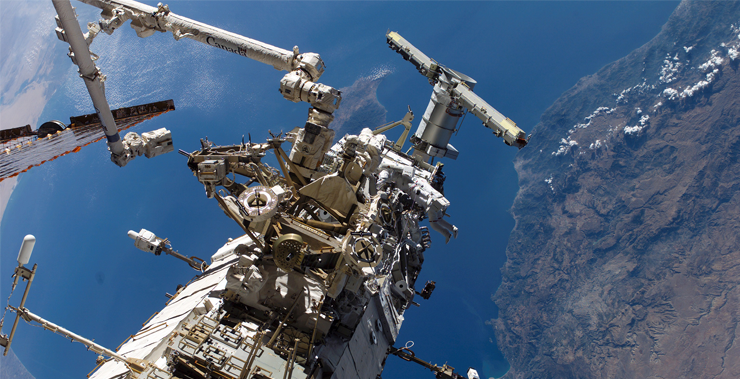
Two U.S. astronauts whipped through a third spacewalk outside the International Space Station on Sunday to rig parking spots for new U.S. space taxis.
Station commander Barry "Butch" Wilmore and flight engineer Terry Virts expected to spend about seven hours installing antennas, cables and navigation aides on the station's exterior truss. Instead, the astronauts, who were making their third spacewalk in eight days, were back inside the space station in 5.5 hours.
The purpose of the outings was to prepare berthing slips for spaceships being developed by Boeing and Space Exploration Technologies, or SpaceX.
Wilmore and Virts floated outside the Quest airlock shortly after 7 a.m. EST/1200 GMT, a NASA Television broadcast showed. Their job was to install more than 400 feet (122 meters) of cables, a pair of antennas and reflectors that the new spaceships will use to navigate toward and dock with the station, a $100 billion laboratory that flies about 260 miles (418 km) above Earth.
After the spacewalk, Virts reported that a small amount of water had seeped into his helmet, a situation that also occurred after a spacewalk last week.
"It's no issue to crew safety," mission commentator Daniel Huot said.
In July 2013, Italian astronaut Luca Parmitano nearly drowned when water began leaking into his helmet. NASA immediately aborted the spacewalk and suspended spacewalks while engineers figured out the cause of the problem. The incident with the suit Virts was wearing is unrelated, NASA said.
Sunday's outing followed two spacewalks last week to rig power and data cables for a pair of docking port adapters that are due to arrive later this year. One adapter will be installed at the berthing slip once used by NASA's space shuttles, which were retired in 2011. The second docking system will be located at an adjacent hatch on the Harmony connecting node.
Since the shuttles' retirement, the United States has been dependent on Russia to fly crew to and from the station, a joint project of 15 nations.
NASA aims to break Russia's monopoly before the end of 2017 by buying rides from Boeing and SpaceX.
Article: Reuters
An unusual pink cloud that lit up the sky over New Mexico and Arizona early on Wednesday was caused by a NASA research rocket launched to study the outer reaches of Earth's atmosphere, scientists said.
The cloud stunned many residents who posted photographs online and speculated on social media about its cause, with theories ranging from shootings stars to the sprightly fictional character Peter Pan.
But researchers at the White Sands Missile Range in southern New Mexico said the fluffy phenomenon had a much more Earth-bound explanation.
They said it was caused by a Terrier-Black Brant rocket designed to reach an altitude of more than 100 miles (160 km) that released a small quantity of vapor - "about as much as is contained in a BBQ grill propane tank" - into the near-vacuum of space to study the formation of the ionosphere.
The ionosphere is the outer layer of the atmosphere that extends to about 370 miles (600 km) into space.
The White Sands scientists said in a statement the colorful cloud was formed "as the sun illuminates the vapor before it diffuses harmlessly away into space."
Ground stations across the U.S. Southwest took a variety of measurements during the experiment, the researchers said. The data will be used to develop enhanced models of ionospheric disturbances in near-Earth space and their effects on modern technologies.
(Reporting by Daniel Wallis in Denver; Editing by Bill Trott)
Two U.S. astronauts finished a 6-1/2-hour spacewalk on Wednesday to prepare parking spots for new commercial space taxis then discovered water had leaked into a spacesuit helmet, a problem that led to the near-drowning of another astronaut in 2013, officials said.
Unlike the 2013 incident, astronaut Terry Virts was not in any danger, said NASA mission commentator Rob Navias.
Virts discovered a small amount of water was floating in his helmet after he and spacewalk partner Barry "Butch" Wilmore had returned to the station's airlock following a successful outing.
"I really can't see any immediate danger," station flight engineer Samantha Cristoforetti of Italy radioed to ground control teams at Mission Control in Houston.
In July 2013, NASA hastily aborted a spacewalk when the helmet worn by Italian astronaut Luca Parmitano began filling with water. By the time he returned to the airlock, his vision was blocked and communications equipment had stopped working.
NASA suspended spacewalks while engineers searched for the cause of the problem.
Engineers do not yet know why Virts’ helmet leaked, nor if the issue is related to the previous problem, Navias said.
NASA managers plan to meet on Friday to decide whether to proceed with Sunday’s outing, he added,
During Wednesday’s spacewalk, the astronauts removed a cover protecting the space shuttle’s docking port, one of two sites being reconfigured for new spaceships under development by Boeing and Space Exploration Technologies, or SpaceX.
The work paves the way for the arrival later this year of two international docking port adapters, which will be installed during four more spacewalks NASA plans in 2015.
The spacewalkers finished routing two power and data cables on Wednesday then greased the grapple fixture at the end of the station’s robot arm.
They also prepared the Tranquility connecting node for the September arrival of an experimental inflatable habitat built by privately owned Bigelow Aerospace. Sunday's spacewalk is devoted to setting up a new communications system for the visiting vehicles.
The station, a partnership of 15 nations, is a collection of laboratories and platforms for materials and life science experiments, Earth studies, physics and other investigations that take advantage of the microgravity environment and unique vantage point of space. The Russian space agency Roscosmos said on Tuesday it would remain part of the international outpost until 2024, a four-year extension proposed by the United States.
Source: Reuters
Last October's explosion of Orbital ATK Inc's Antares rocket may have been triggered when debris inadvertently left in a fuel tank traveled into the booster's main engine, two people familiar with investigations into the accident told Reuters.
The sources said the preliminary findings suggest that a simple assembly mistake by Orbital ATK could have caused the explosion, which destroyed a cargo ship bound for the International Space Station.
Orbital initially linked the explosion to a problem with the turbo pump in one of the two Soviet-era NK-33 engines that power the rocket. GenCorp Inc's Aerojet Rocketdyne unit refurbishes the old motors and resells them as AJ-26 motors.
Orbital ATK on Friday acknowledged that so-called "foreign object debris" was one of more than a half dozen credible causes of the explosion, but said it was not "a leading candidate as the most probable cause of the failure."
Orbital spokesman Barry Beneski said the company-led "accident investigation board," which includes officials from NASA and the Federal Aviation Administration, had not identified any evidence of mishandling of the flight hardware by Orbital.
He said Orbital continued to compare data from the October explosion with a May 2014 test stand failure of a different AJ-26 engine, and prior failures involving AJ-26 ground tests in 2009, 2011 and 2012.
No details have been released on the May 2014 test stand incident, but sources familiar with the earlier investigation said it was likely linked to faulty "workmanship" on the original motor, and additional inspections had been mandated to prevent mishaps with other engines. Orbital also successfully launched one Antares rocket in July 2014, after the May incident.
NASA spokeswoman Stephanie Schierholz said NASA was conducting its own internal "lessons learned" review of the accident, but declined to give any details about individual aspects of the investigation.
She agreed with Orbital that foreign object debris was always considered as a possible cause in aerospace accidents.
If the investigations confirm that debris from the fuel tanks caused the Antares explosion, that could have significant financial and legal effects for Orbital ATK, which was formed by the merger of Orbital Sciences Corp and Alliant Techsystems.
The new findings could also open the door for a legal claim against Orbital by GenCorp, which took a $17.5 million loss in October, after Orbital said the accident had prompted it to accelerate plans to switch to a different engine.
One source said the Orbital investigation could end without declaring a single "root cause" for the explosion. Probes of past accidents have had similar results.
Several sources said it may be difficult to determine conclusively whether the debris entered the engine before the explosion, or as a result of it.
Glenn Mahone, spokesman for Aerojet Rocketdyne, declined to comment on the investigations, noting that they were still underway. He also declined to comment on the cause of the May test stand failure, which is part of the investigation.
One of the sources familiar with the probe said investigators found particles of a crystallized desiccant, or drying agent, in the turbo pump and other parts of the AJ-26 engine. The crystals could have caused sparks and triggered a fire when they hit the turbo pump in the oxygen-rich environment, the source said.
Desiccants are often used to control moisture in fuel tanks but need to be removed before takeoff, the sources said.
While the NASA investigation had not finalized the root cause of the accident, there were multiple signs that suggested some "foreign object debris" had been ingested into the engine from the fuel tanks, one source said.
Antares had four previous successful flights. The Oct. 28 explosion was the first accident since NASA began using commercial providers to fly cargo to the space station.
Orbital already faces steep bills for damage to the launch site, and the need to buy a different rocket to launch its next cargo ship to the space station.
In December, the company said it would buy a booster from United Launch Alliance, a joint venture of Lockheed Martin Corp and Boeing Co, to meet its obligations under a $1.9 billion cargo supply contract with NASA.
Orbital is one of two companies NASA hired to fly 40,000 pounds of cargo each to the station following the retirement of the space shuttles in 2011. Privately held Space Exploration Technologies, or SpaceX, has the other contract, valued at $1.6 billion.
(Reporting by Andrea Shalal; Editing by David Gregorio)
A pair of U.S. astronauts floated outside the International Space Station on Saturday to begin rigging parking spots for two commercial space taxis.
Station commander Barry “Butch” Wilmore, 52, and flight engineer Terry Virts, 47, left the station’s Quest airlock shortly before 8 a.m. EST/1300 GMT to begin a planned 6-1/2-hour spacewalk, the first of three outings over the next eight days.
The work will prepare docking ports for upcoming flights by Boeing Co and privately owned Space Exploration Technologies, or SpaceX, which are developing capsules to ferry crew to and from the station, which flies about 260 miles (418 km) above the Earth.
The United States has been dependent on Russia for station crew transportation since the space shuttle were retired in 2011.
The first test flight of a new U.S. crew craft isn’t expected until late 2016, but the station, a $100 billion laboratory owned by 15 nations, needs to undergo a significant transformation to prepare for the new vehicles, NASA said.
That work began on Saturday with Wilmore and Virts installing six cables to a docking port on the station’s Harmony module, the same site where space shuttles used to berth.
"This will be the most complicated cable-routing task that we have performed (by spacewalkers) to date,” Karina Eversly, lead spacewalk official, told reporters at a news conference on Wednesday.
After two more spacewalks scheduled for Wednesday, Feb. 25, and Sunday, March 1, the station will be outfitted with a total of 764 feet (233 m) of new cabling, as well as a communications system to support Boeing’s CST-100 and SpaceX’s upgraded Dragon capsules.
The work sets the stage for the launch and installation of two international docking systems, built by Boeing and scheduled for launch aboard SpaceX Dragon cargo ships later this year.
To make room for a second berthing port on Harmony and two docking slips for cargo ships, NASA also plans to relocate another module using the station’s robot arm.
"We're doing a lot of reconfiguration this year," Kenneth Todd, station operations manager, said at the news conference. "We are really trying to take the station into this next phase.”
Credits: Reuters