Showing posts with label Mars. Show all posts

Giving shape to black holes' intense winds


By looking at the speed of ambient gas spewing out from a well-known quasar, astronomers are gaining insight into how black holes and their host galaxies might have evolved at the same time.

Using the Nuclear Spectroscopic Telescope Array (NuSTAR) , researchers were able to use the X-ray spectra of an extremely luminous black hole (quasar PDS 456) to detect a nearly spherical stream of highly ionized gas streaming out of it.

The discovery allowed astronomers to measure, for the first time, the strength of ultra-fast black hole winds and show that they are mighty enough to affect the fate of their host galaxies.

The evolution of galaxies is connected to the growth of supermassive black holes in their centers. During the quasar phase, a huge luminosity is released as matter falls onto the black hole, and radiation-driven winds can transfer most of this energy back to the host galaxy.

"We know that black holes in the centers of galaxies can feed on matter, and this process can produce winds. This is thought to regulate the growth of the galaxies," said Fiona Harrison of the California Institute of Technology, the principal investigator of NuSTAR and a co-author on a new paper about the results appearing in the Feb. 19 issue of the journal Science. 

"Knowing the speed, shape and size of the winds, we can figure out how powerful they are."

Supermassive black holes blast matter into their host galaxies, including X-ray-emitting winds traveling at up to one-third the speed of light. In the new study, astronomers determined that PDS 456, an extremely luminous active black hole, or quasar, has winds that carry more energy every second than what is emitted by more than 1 trillion suns.

That's enough of a punch to affect the entire galaxy and its ability to make stars.
"By looking at this huge spherical outflow, we can now see a mechanism to explain the correlation between black hole and galaxy formation," said Bill Craig of Lawrence Livermore National Laboratory and the Space Science Laboratory at University of California, Berkeley.

NuSTAR and the European Space Agency's XMM-Newton simultaneously observed PDS 456, located more than 2 billion light-years away, on five separate occasions in 2013 and 2014. The space telescopes complement each other by seeing different parts of the X-ray light spectrum: XMM-Newton sees low-energy X-rays and NuSTAR sees high-energy X-rays. Their goal was to look for iron, which is blown from the black hole winds along with other matter.

The researchers looked for scattered light signatures from iron atoms originating from the sides of the supermassive black hole.
The NuSTAR's higher-energy X-ray data, when combined with observations from XMM-Newton, provided the key information, proving that the winds emanate not in a beam but in a nearly spherical fashion.

With the shape and extent of the winds determined, the researchers could then determine the power of the wind and the degree to which they can quench the formation of new stars.

The new report demonstrates that a supermassive black hole and the galaxy that nurtures it are connected by high-speed winds. As the black holes bulk up in size, their winds push vast amounts of matter outward through the galaxy, which ultimately stops new stars from forming.

The above story is based on materials provided by DOE/Lawrence Livermore National Laboratory. Note: Materials may be edited for content and length.

Mars exploration: NASA's MAVEN spacecraft completes first deep dip campaign


NASA's Mars Atmosphere and Volatile Evolution has completed the first of five deep-dip maneuvers designed to gather measurements closer to the lower end of the Martian upper atmosphere.

"During normal science mapping, we make measurements between an altitude of about 150 km and 6,200 km (93 miles and 3,853 miles) above the surface," said Bruce Jakosky, MAVEN principal investigator at the University of Colorado's Laboratory for Atmospheric and Space Physics in Boulder. "During the deep-dip campaigns, we lower the lowest altitude in the orbit, known as periapsis, to about 125 km (78 miles) which allows us to take measurements throughout the entire upper atmosphere."

The 25 km (16 miles) altitude difference may not seem like much, but it allows scientists to make measurements down to the top of the lower atmosphere. At these lower altitudes, the atmospheric densities are more than ten times what they are at 150 km (93 miles).

"We are interested in the connections that run from the lower atmosphere to the upper atmosphere and then to escape to space," said Jakosky. "We are measuring all of the relevant regions and the connections between them."

The first deep dip campaign ran from Feb. 10 to 18. The first three days of this campaign were used to lower the periapsis. Each of the five campaigns lasts for five days allowing the spacecraft to observe for roughly 20 orbits. Since the planet rotates under the spacecraft, the 20 orbits allow sampling of different longitudes spaced around the planet, providing close to global coverage.

This month's deep dip maneuvers began when team engineers fired the rocket motors in three separate burns to lower the periapsis. The engineers did not want to do one big burn, to ensure that they didn't end up too deep in the atmosphere. So, they "walked" the spacecraft down gently in several smaller steps.

"Although we changed the altitude of the spacecraft, we actually aimed at a certain atmospheric density," said Jakosky. "We wanted to go as deep as we can without putting the spacecraft or instruments at risk."

Even though the atmosphere at these altitudes is very tenuous, it is thick enough to cause a noticeable drag on the spacecraft. Going to too high an atmospheric density could cause too much drag and heating due to friction that could damage spacecraft and instruments.

At the end of the campaign, two maneuvers were conducted to return MAVEN to normal science operation altitudes. Science data returned from the deep dip will be analyzed over the coming weeks. 

The science team will combine the results with what the spacecraft has seen during its regular mapping to get a better picture of the entire atmosphere and of the processes affecting it.

One of the major goals of the MAVEN mission is to understand how gas from the atmosphere escapes to space, and how this has affected the planet's climate history through time. In being lost to space, gas is removed from the top of the upper atmosphere. But it is the thicker lower atmosphere that controls the climate. MAVEN is studying the entire region from the top of the upper atmosphere all the way down to the lower atmosphere so that the connections between these regions can be understood.

Credits: ScienceDaily


Mars One mission: Watch the trailer for £4bn colonisation programme


Five Britons have been shortlisted for a one-way trip to Mars as they hope to become the first humans to step foot on the Red Planet.

Four women and a man from the UK are among the final 100 candidates for the Mars One Project which plans to set up a permanent human settlement on the planet by 2024.
More than 200,000 people applied for the controversial privately-funded mission that organisers have estimated will cost £3.9 billion and is set to be filmed for a reality television series.

Hannah Earnshaw, 23, a PhD student in astronomy at Durham University, is among the British hopefuls, who include students and researchers in physics and astrophysics, a science lab technician and a manager for Virgin Media.

She said: "Human space exploration has always interested me so the opportunity to be one of the people involved was really appealing. The future of humanity is in space.
"My family is pretty thrilled. They're really happy for me. Obviously it's going to be challenging, leaving Earth and not coming back. I've had support from my friends and family and we can still communicate via the internet."


Ms Earnshaw said she will now be tested in groups on her response to stressful situations before finding out at the end of the year if she has made the list of 24 people chosen for the mission.
There will then be eight or nine unmanned trips to Mars before the first group of four astronauts will be launched into space in 2024, she said.

Ms Earnshaw said she was "not surprised" by scepticism surrounding the project. Last year researchers at the Massachusetts Institute of Technology reportedly found that any manned mission to Mars would result in the crew dying after 68 days, while critics have pointed out that the estimated cost of Mars One is a fraction of the amount proposed by Nasa.

Ms Earnshaw said: "It's a very ambitious mission and requires lots of things going right for humans to leave the planet. But this project is encouraging other people to talk about the wider implications.
"It's definitely feasible. Space travel is risky but at the same time, there is a time scale in place."

The other British hopefuls are Dr Maggie Lieu, 24, a PhD in Astrophysics at the University of Birmingham, Oxford University student Ryan MacDonald, 21, from Derby, Alison Rigby, 35, a science laboratory technician, from Beckenham, Kent, and Clare Weedon, 27, a systems integration manager for Virgin Media, from Addlestone, in Surrey.

In total, 50 men and 50 women have been shortlisted from around the world, including 39 from the Americas, 31 from Europe, 16 from Asia, seven from Africa and seven from Oceania.

They were selected from a pool of 660 candidates after taking part in online interviews with the mission's chief medical officer Norbert Kraft, where they were tested on their understanding of the risks involved, team spirit and motivation to be part of the expedition.

Dutch entrepreneur Bas Lansdorp, co-founder of Mars One, said: "The large cut in candidates is an important step towards finding out who has the right stuff to go to Mars. These aspiring martians provide the world with a glimpse into who the modern day explorers will be."

Candidates that were not selected will have a chance to re-apply in a new application round that will open in 2015.


Credits: Telegraph.co.uk


Back to Mars One mission: 100 hopefuls shortlisted for chance to leave Earth forever


Amateur astronauts hoping to make history by leaving Earth to live on Mars have been shortlisted for the one-way trip of a lifetime.
The final 100 candidates from the Mars One project have been whittled down from more than 200,000 applicants following an exhaustive selection process, which began in April 2013.

“The large cut in candidates is an important step towards finding out who has the right stuff to go to Mars,” said Dutch billionaire Bas Lansdorp, co-founder & CEO of Mars One.

“These aspiring Martians provide the world with a glimpse into who the modern day explorers will be.”

The 50 men and 50 women were selected for round three of the process after coming through an online interview with the project’s chief medical officer.

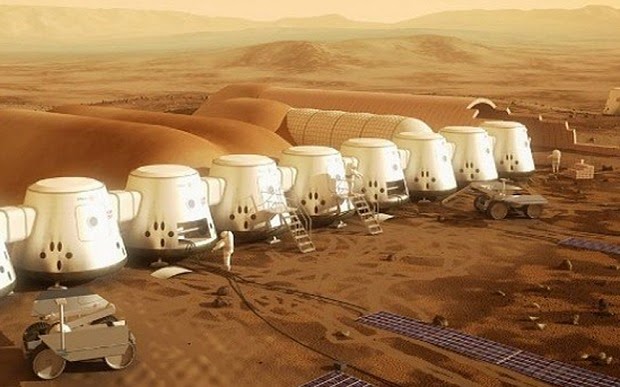
Mars One wants to put humans on the Red Planet by 2024  Photo: Mars One

Those who made it through the interview stage showed they understood the risks involved and demonstrated a strong willingness to work in a team.
The final 100 chosen come from around the world, with 39 from the Americas, 31 from Europe, 16 from Asia, 7 from Africa, and 7 from Oceania.

Ambitious: Mars One


A total of 40 candidates will eventually be chosen to take part in a training programme and live in a copy of the Mars outpost on Earth.
Mars One wants to put a permanent human settlement on Mars, with the first crew of four to reach the Red Planet by 2024 and the mission set to be turned into a reality TV show.
Over the next few years, communication satellites, two rovers and several cargo missions will be sent to Mars.

However, sceptics have cast serious doubt over whether the Mars mission will ever be achieved.

The Psychology of Mars One Hopefuls


Studies show that it takes a certain kind of crazy to volunteer for a trip to Mars.
In the two years since the non-profit Mars One announced its plan to colonize the planet, more than 200,000 people have applied to be among the first humans to die on Mars (and probably do some other stuff there too). Now, the Netherlands-based organization has narrowed down the group to 660 lucky individuals. A documentary from the Guardian released on Monday gives viewers a glimpse into these space hopefuls' mindset.

“A hundred years down the line, who’s going to know who was the president of the United States or something?” asked one Mars One finalist from the United Kingdom, named Ryan, in a video made by Stateless Media. “But everyone will remember who were those first four people who stepped on Mars.”


A slew of personality traits have also been linked to risk-taking behavior, including narcissism, impulsivity, extroversion, aggression, and sensation seeking. Or, as another Mars hopeful, Dina, told Stateless Media: “It might put me in danger. But that’s the whole point.”

Humans are, by our nature, explorers. Our ancestors fanned out across the globe by land and sea, and once they reached Earth’s highest peaks and deepest trenches, we took to the stars. The Mars One astronauts will join an exclusive club of explorers who have stepped onto other worlds. They will be celebrated, remembered, deified. But they will never come back.

Though we may be genetically predisposed to explore, it takes a special kind of person to trade this blue planet for a red one. In the Psychology of Space Exploration, psychologists Albert Harrison and Edna Fiedler wrote of what previous Soviet and NASA missions have taught us about the behavioral health issues that can arise when humans are forced together in confined spaces, say, a spacecraft:

Members of isolated and confined groups frequently report sleep disturbances, somatic complaints (aches, pains, and a constellation of flulike symptoms sometimes known as the “space crud”), heart palpitations, anxiety, mood swings including mild depression, inconsistent motivation, and performance decrements. Crew members sometimes withdraw from one another, get into conflicts with each other, or get into disputes with Mission Control.

The astronauts of the Apollo 7 crew never flew again thanks to confrontations with mission control. Several other missions Soyuz 21, Soyuz T-14, and Soyuz TM-2 were shortened because of mood or other psychological health related issues. Mars One candidates will not have the option to bail out early (or ever, really).

What makes for a good space traveller? Aside from intelligence and a certain degree of insanity, these candidates probably have a little extra dopamine a neurotransmitter associated with (among many, many other things) reward. Risk-takers tend to have fewer dopamine receptors in the reward circuits of their brains, according to a 2008 study. Fewer receptors to recycle free-floating dopamine means a heavier dosage of the brain chemical. Higher risks result in higher rewards, or higher levels of dopamine.

A slew of personality traits have also been linked to risk-taking behavior, including narcissism, impulsivity, extroversion, aggression, and sensation seeking. Or, as another Mars hopeful, Dina, told Stateless Media: “It might put me in danger. But that’s the whole point.”

Whatever their reasons guts, glory, or straight up genetics there is no shortage of people willing to leave this rock we call home behind. But until the Mars One non-profit actually launches four amateur astronauts toward the red planet, China (and I) still think Mars One might just be a long-running and elaborate hoax.

Credits: PSMAG